The metrics onion: How Instabee Group decides which metrics to define centrally
October 28, 2026·7 min read

Data teams are told to ship trusted metrics instead of dashboards. But if every metric request becomes a governance exercise, nothing ships. Instabee Group’s data platform team uses a simple model to decide where to spend their effort.

The governance trap
Every data leader knows the problem. Two people bring two different numbers to the same meeting, and everyone spends the first ten minutes trying to work out who’s right.
The fix is to define your metrics once, govern them centrally, and make everyone use the same version. That’s the heart of a metrics-first approach. Instead of shipping another dashboard, the data team ships trusted metrics that work everywhere, from reports and apps to AI agents.
But metrics-first raises a new question. An operations manager might track 50 numbers a day. A commercial team wants a new cut every week. Does every one of those need a definition workshop, an owner and a sign-off? Treat them all the same, and governance stops enabling the business and starts slowing it down.
So the question isn’t whether to govern metrics. It’s how much, and which ones.
At a recent Steep breakfast, Sven Venema, Product Manager at Instabee Group, explained how his team answers that question. He called it the metrics onion.
Building data products, not dashboards
Instabee Group, the company behind Budbee, Instabox and Porterbuddy, serves thousands of online merchants and millions of consumers across six markets. As its data and AI ambitions have grown, the data team has moved from building dashboards to building data products: shared, well-defined metrics that teams can use wherever they work.
Definitions sit at the center of that approach. “We’re obsessed with definitions,” Sven says. “If we can agree on the definition, then we can use the metric.”
Instabee has its own AI Data Catalogue, the Data Butler. Ask it about volume, and it knows to distinguish between, for example, created, delivered and scanned parcels.
The metrics onion
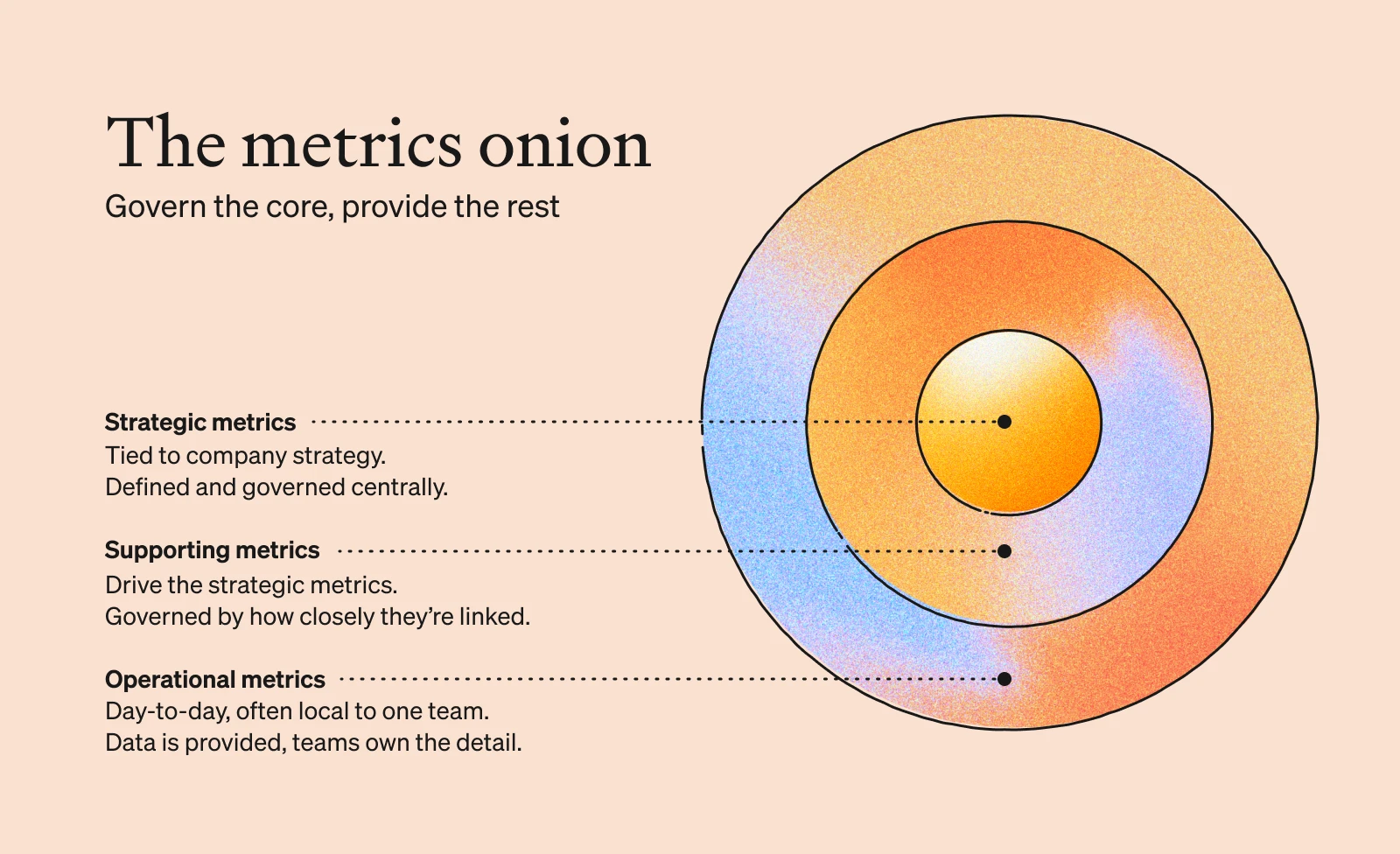
Instabee’s approach is that governance isn’t one setting, but a gradient. Sven describes it as layers of an onion:
- The core: strategic metrics. These tie directly to company or department strategy. They are defined carefully, signed off by an owner and governed centrally.
- The middle: supporting metrics. These help explain and drive the core metrics. Some sit very close to strategy and need the same care. Others sit further out and need less.
- The outer layer: operational metrics. The day-to-day numbers people use to run their work. They matter, but they change often and are usually local to one team.
“Someone working day-to-day in operations might have 50 metrics they look at. But do all 50 need to become centrally governed metrics? Probably not.”
This isn’t an argument for governing less. Every metric people rely on should be trustworthy.
The question is who defines it and how much process it needs.
Core metrics get the full treatment: owners, sign-off, central definitions. Further out, teams define their own metrics, but on top of the same trusted data and core definitions — not in a spreadsheet on the side.
Definer at the core, provider at the edge
The most useful part of the model is what changes about the data team’s job as you move through the layers.
“The further out you get on the onion, the more the data team becomes a data provider rather than a definer.”
Sven Venema, Product Manager at Instabee Group
At the core, the data team works with metric owners to agree exactly what a number means. On the outside, its job is to make good data available and let the people closest to the work decide how to use it. As Sven puts it, sometimes the answer is: “This metric is important, and we’ll give you the data, but we don’t necessarily need to define and govern it centrally.”
Steep CEO Johan Baltzar, who moderated the panel, added a useful rule of thumb. For around 80 to 90% of metrics, the data team can propose a sensible definition, because they know the data and the common questions. Then there’s “the juicy 10%”, such as exactly how to define margin, where you need a real debate with the business.
That’s where the effort belongs: not spread evenly across hundreds of metrics, but focused where the business genuinely needs to debate.
How Instabee decides what goes where
So how do you work out which layer a metric belongs in, and who gets a say?
Instabee starts with strategy and works backwards:
- Tie the metric to strategy. Is it part of company strategy, a department’s strategy, or neither? That decides how close to the core it sits.
- Find the real stakeholders. Who set the strategy? Who actually uses the number? That tells you who needs to be in the room for the definition, and who doesn’t.
- Let owners sign off. Department heads and metric owners map out what should be measured and approve the definitions and business logic.
- Make the data team the counterpart. The data team’s role is to explain the consequences: if we define it this way, what happens? What are the technical implications? What are the options?
- Take a stance when needed. “Sometimes you need to take a stronger stance as the data team,” Sven says. Not every metric needs a central sign-off.
This approach also reflects how people actually use data. Sven estimates that around 85% of users just want to track a KPI or follow a number. About 10% want deeper analysis, and perhaps 5% are “the real data wizards”. Governed core metrics serve that 85% far better than another dashboard.
Instabee makes those core metrics available wherever people work. Some teams use them directly in Steep, while others use Instabee’s own internal AI assistant, built on the same metrics. “The important thing is that we can start with one trusted answer,” Sven says. “From there, people can make decisions and interrogate the data further.”
Sign-off is just the beginning
Agreeing on a definition once is the easy part. Keeping it right over time is the next challenge, and Sven is already designing the longer-term governance model:
“If something changes six months later, how do we make sure people know about it? How do we make sure the owner remains an active owner, rather than signing off once and assuming the metric will be correct forever?”
Sven Venema, Product Manager at Instabee Group
The data team runs roadshows with department heads and maps their metrics with them, so ownership stays active rather than becoming a one-off approval.
And the pace is picking up. Sven describes the team as having reached “rocket speed”, and the next goal is 100% metric completion, with every core metric defined, owned and available across the business.
Govern the core, provide the rest
If you’re moving your team from shipping dashboards to shipping trusted metrics, Instabee’s approach gives you a practical starting point.
Five rules for right-sizing metric governance
- Start with strategy. Map your strategic metrics first. They are your core.
- Govern by layer, not by request. Decide how much governance a metric needs based on where it sits, not who asked for it.
- Spend your debate on the 10%. Propose sensible definitions for most metrics, and save the real discussion for the few that need it.
- Be a provider at the edge. Let teams define operational metrics on the same trusted data.
- Keep owners active. Treat sign-off as the start of ownership, and revisit definitions as the business changes.
This is what metrics-first really means for analysts: less time answering the same question ten ways, more time defining the answers that matter. And as more people work through AI agents, those well-defined core metrics become the thing everything else depends on.
That’s the idea behind Steep: one set of governed metrics that powers every report, app and agent, so the answers stay consistent wherever people work. Read the Instabee customer story here.

Book a demo
Get help with exploring the platform and discussing use cases for your team.
Get started
Explore for free. Get your own workspace or try the demo setup.
More posts

Intro to Steep
By Janna Pollari·Events

Webinar with Daana
By Janna Pollari·Events

Meet us at Snowflake Summit 2026
By Deanne Anderson·Events
Introducing Steep AI
By Nino Höglund·Product

A builder's guide to the Steep API
By Hanna Kjellén·Inside Steep

New in Steep: API – Metrics power anything
By Nino Höglund·Product