What is a semantic layer? Definition, types and why AI needs one
October 22, 2026·12 min read

A semantic layer is a shared set of business definitions (metrics like revenue, active users and churn) that sits between your data warehouse and the tools that use it. It defines how each metric is calculated once, so BI dashboards, spreadsheets and AI assistants all return the same numbers.

Marketing says revenue is up 12%. Finance says 8%. Then someone asks an AI assistant and gets 10%. All three pulled from the same data warehouse and used what they thought was the right definition. So who’s right?
Neither. Or both. And that’s the problem.
Instead of making decisions, teams end up spending meetings reconciling numbers. Analysts are pulled into explaining calculations, reports get questioned, and people become less confident in the data they’re supposed to rely on.
The fix isn’t more reports, more SQL training or a smarter AI model. It’s a semantic layer: one shared set of business definitions, so teams, tools and AI systems all work from the same numbers.
Semantic layer definition and examples
A semantic layer is a system that translates raw data into familiar business concepts, such as revenue, active users and churn. It defines how those metrics are calculated and how they relate to the underlying data, so different tools and people can use the same definitions.
When a data team builds a semantic layer, they define things like:
- Revenue = sum of completed transactions, excluding refunds, in the selected currency
- Active user = any user who logged in and performed at least one action in the last 30 days
- Churn rate = customers lost in a period divided by customers at the start of that period
These are illustrative definitions, with the exact logic depending on the business, and agreeing on that logic is part of what makes a semantic layer useful.
Once defined, those definitions power everything: your BI reports, your AI analytics assistant, your executive summaries, your Slack alerts and other connected tools.
Rather than each tool rebuilding the calculation independently, they can draw on the same governed definitions. This reduces inconsistencies and makes it easier to understand where a number comes from.
A note on terminology
Steep is a semantic platform, and your definitions live in Steep’s semantic model. We use “model” because it goes beyond metrics and dimensions to include entities, targets, access rules and AI context. For the rest of this post, we will use semantic layer as the industry-standard term.
What problem does a semantic layer solve?
AI that cannot be trusted
AI assistants can now answer data questions in seconds, but their answers are only as good as their understanding of your data.
Without a semantic layer, an AI tool has to work out from raw tables what “active user” or “revenue” means, and it may work it out differently each time. Ask the same question twice and you can get two different answers, with no way to tell which is right.
A semantic layer gives AI tools explicit definitions of each metric and how metrics relate to each other, so their queries are grounded in approved business logic. It doesn’t eliminate every AI error, but it means the AI uses your definitions instead of guessing.
Metric disagreements
When teams define metrics in their own reports or spreadsheets, inconsistencies are inevitable. Marketing’s conversion rate filters by campaign source. Sales’ conversion rate counts all closed deals. The data is the same but the logic is different. The result is a meeting spent debating whose number is right instead of acting on it.
A semantic layer gives teams a shared definition to work from, while still allowing them to explore different segments, time periods and dimensions.

Report sprawl
Without a shared source of metric truth, every team builds their own report. Then every report drifts. Definitions start to diverge behind the scenes. Filters get added or removed. By the time the company has 200 reports, nobody trusts any of them, and the data team spends most of its time fielding questions about which number to use.
A semantic layer helps prevent this by keeping metric logic centralized, rather than buried inside individual reports.
Analyst bottlenecks
Business users can’t self-serve when data requires SQL expertise or intimate knowledge of table schemas. So they queue up analyst requests. Analysts spend their days answering repeat questions instead of doing the analysis that actually moves the business.
When paired with an accessible analytics tool, a semantic layer allows people to explore governed metrics using familiar business terms, without having to understand the underlying SQL.
How does a semantic layer work?

The exact setup varies, but most semantic layers follow three steps:
- Define: Your data team defines metrics, dimensions, entities, join paths, access rules and, in some tools, targets and AI context such as synonyms in the semantic layer.
- Govern: Those definitions are managed centrally, so teams can reuse consistent business logic across their analytics.
- Use: Every connected tool, from BI platforms to AI assistants and agents, queries the semantic layer instead of writing raw SQL against the warehouse.
Some semantic layers operate as independent services. Others are built into BI platforms or data warehouses. Features such as caching, query optimization and access control depend on the implementation.
In Steep, you connect directly to your data warehouse (Snowflake, BigQuery, Databricks and others) and define your semantic model in code or in the in-app editor. That model powers exploration, reporting and AI analysis.
Read: 5 key requirements for a successful semantic layer
Types of semantic layers
Semantic layers differ mainly in where the definitions live and which tools can use them.
Standalone semantic layer tools
Tools like dbt’s Semantic Layer and Cube are purpose-built to define metrics and dimensions in a portable, tool-agnostic way.
You define your semantic layer once, and it can feed multiple downstream tools: BI platforms, AI agents, APIs. The strength is portability.
The tradeoff is that they’re mostly code-first, and they take engineering time to set up and maintain.
Using dbt or Cube? Steep integrates with both. If you’ve already defined your semantic layer in either tool, connect Steep and it’ll pull those definitions in.
BI-native semantic layers
Some BI tools have semantic layers built in. Looker’s LookML is the most well-known example. These work well when one tool handles most of your analytics.
Their limitation is portability. While definitions can be accessed through APIs and integrations, using them outside the platform can require additional work.
Warehouse-native semantic layers
Data warehouses increasingly let teams define business metrics where the data lives, for example Snowflake Semantic Views and Databricks Metric Views.
The tradeoff is compatibility. Not every analytics tool can use these definitions automatically, and some integrations require additional setup.
Optional semantic layers in analytics platforms
In these platforms, a semantic layer sits alongside flexible workspaces for SQL, notebooks or spreadsheet-style exploration.
Users can work with governed metrics or create their own calculations directly from warehouse data. This gives analysts more flexibility, but it also means teams need to manage consistency between governed metrics and custom calculations.
Platforms with a semantic model at their core
Here, the semantic model is the foundation of the whole platform. Steep is one example, with every chart, report and AI answer coming from governed definitions. The model is also available to other tools and AI agents through APIs and MCP.
The tradeoff is that data has to be modeled before anyone can explore it, so there’s less room for quick one-off SQL. Most teams start with a handful of core metrics and add more over time, and everything built on them stays consistent from day one.
Your definitions stay yours. Steep lets you manage your semantic model as version-controlled code, while APIs and MCP make governed metrics available to external tools and AI agents. Support for Apache Ossie is designed to make semantic definitions more portable across platforms.
Where should your semantic layer live?
For years, most semantic layers lived inside BI tools, but that’s changing. As AI assistants and agents start querying company data alongside reports, more teams want one set of definitions that every tool can use, not just their BI tool.
That’s why portability now matters as much as features. When comparing options, ask: Can other tools and AI agents use these definitions? Are they stored as code you can version and export? Do they support open standards?
Whichever option you choose, keep one writer per metric: one place where each definition can be changed, with every other tool reading from it. Two editable copies of “revenue” is how drift starts again.
Apache Ossie (formerly Open Semantic Interchange, or OSI) is the main emerging standard here. Backed by Snowflake, dbt Labs, Salesforce, Databricks and other organizations, it defines a vendor-neutral format for semantic definitions so they can move between tools without being rebuilt. The specification is still evolving, but it represents a step toward making semantic definitions more portable.
What a semantic layer looks like in practice
You’re the Head of Growth at a SaaS company. Your team just shipped a new onboarding flow and you want to understand how it affected user retention.
Without a semantic layer: You ask an AI assistant: “Did the new onboarding flow improve 30-day retention?” It writes its own SQL against the raw tables, picks its own definition of “active user”, and gives you a confident answer. Then Finance shows a different retention number in the board meeting, and nobody can explain the gap.
With Steep’s semantic model: You ask the same question, in Steep AI or in an assistant like Claude or ChatGPT connected through MCP. The AI uses the governed Active Users metric and its built-in cohorts, so it compares pre-launch and post-launch cohorts using the same definition Finance and Product use. You ask a follow-up (“Which acquisition channel improved most?”), get an answer on the same definitions, then open the live cohort report to dig deeper and share it with your team before the meeting.
Do you need a semantic layer?
You probably need one if:
- People use AI assistants to answer data questions, or you plan to let them
- Analysts spend more time explaining numbers than analyzing them
- Teams regularly report different numbers for the same metric
- The same metric is rebuilt in several tools, such as a BI tool, spreadsheets and a notebook
You may not need one yet if one or two people own all reporting, you have a handful of metrics in one tool, and nobody outside that group uses the data. Even then, agreeing definitions early is far easier than untangling them once reports multiply.
Getting started with a semantic layer in Steep
Steep is built around the idea that your semantic model should power everything: exploration, reporting, AI analysis and the definitions your whole company relies on. Connect your data warehouse, define your metrics, and everyone can explore the same governed numbers, in Steep or through AI assistants connected via MCP.
If you’re already using dbt or Cube, Steep connects to both and can read your existing semantic definitions, so you don’t have to start from scratch.
Steep is free for up to 3 users. Create a free workspace in Steep →
FAQs
What’s the difference between a semantic layer and a data warehouse?
A data warehouse stores your raw data. A semantic layer sits on top of it and defines what that data means in business terms. They work together: the semantic layer queries the warehouse and serves results to analytics tools in a consistent, business-friendly form.
What’s the difference between a semantic layer and dbt?
dbt is a transformation tool used to clean and model raw data. It also has a semantic layer for defining metrics in code. Steep integrates with dbt’s semantic layer, meaning you can define your metrics in dbt and connect Steep to use those definitions.
What’s the difference between a semantic layer and a metrics layer?
A metrics layer focuses on defining and calculating business metrics like revenue, churn and active users. A semantic layer typically goes further, covering dimensions (such as region or channel), relationships between data and sometimes access rules. In practice, the terms often overlap, and many modern tools support both.
Do AI assistants need a semantic layer?
For reliable answers, yes. AI assistants can query raw data directly, but they have to infer what each business metric means, and they may infer it differently each time. A semantic layer gives them governed definitions to work from, so answers stay consistent with the numbers your teams already use.
What is Apache Ossie (OSI)?
Apache Ossie, formerly Open Semantic Interchange (OSI), is an open standard for sharing semantic definitions (metrics, dimensions and relationships) between tools. Snowflake launched it in 2025 together with partners including Salesforce and dbt Labs, and it’s now an Apache Software Foundation incubator project. It aims to stop definitions being locked inside a single vendor’s tool.
Is a semantic layer only for large companies?
No. The pain it solves appears as soon as a team has more than a handful of people using data. Small teams benefit from governed metrics early, and it’s far easier to agree definitions before reports multiply.
Book a demo
Get help with exploring the platform and discussing use cases for your team.
Get started
Explore for free. Get your own workspace or try the demo setup.
More posts

Intro to Steep
By Janna Pollari·Events
Webinar with Daana
By Janna Pollari·Events

Meet us at Snowflake Summit 2026
By Deanne Anderson·Events
Introducing Steep AI
By Nino Höglund·Product

A builder's guide to the Steep API
By Hanna Kjellén·Inside Steep
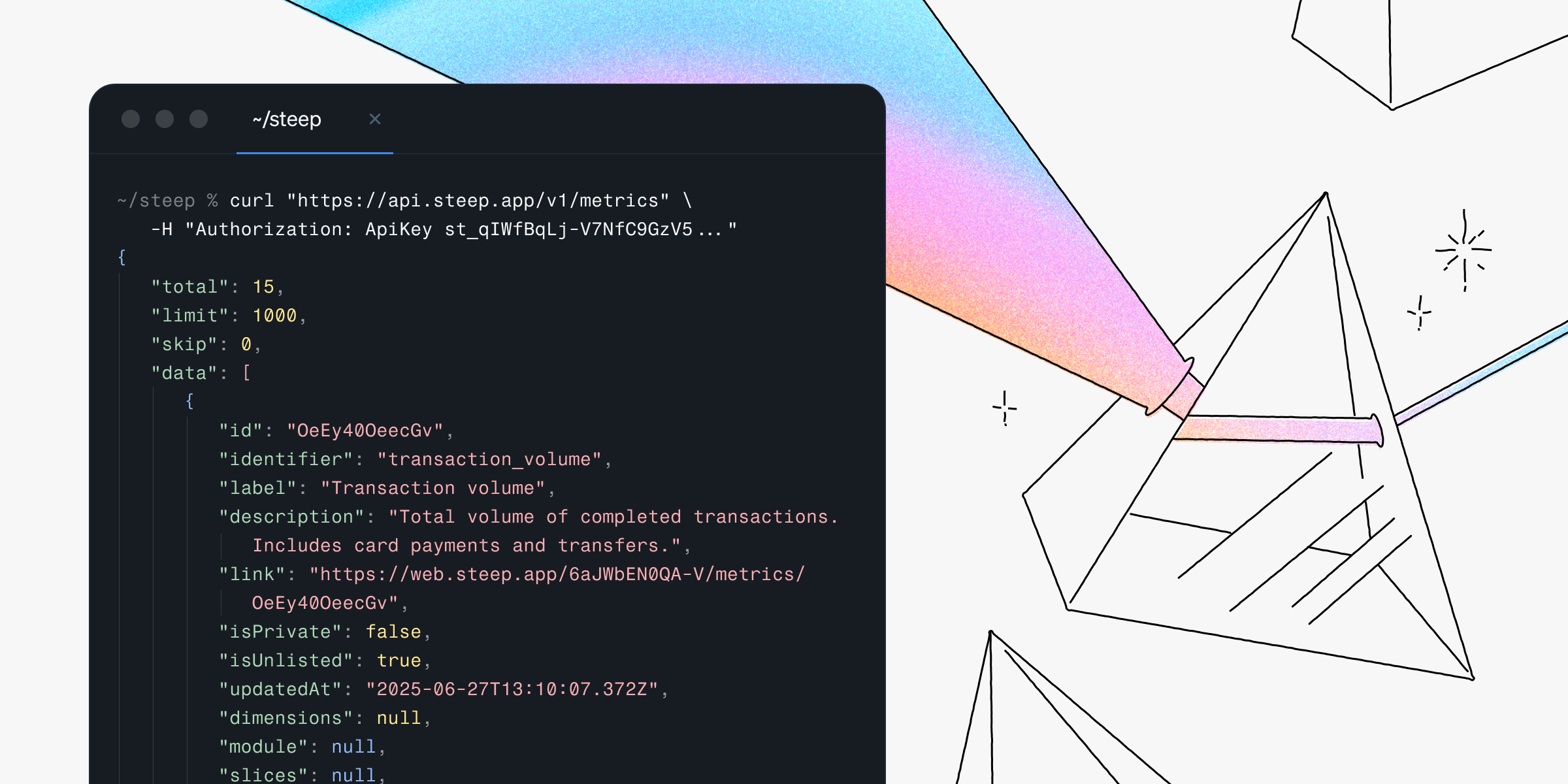
New in Steep: API – Metrics power anything
By Nino Höglund·Product