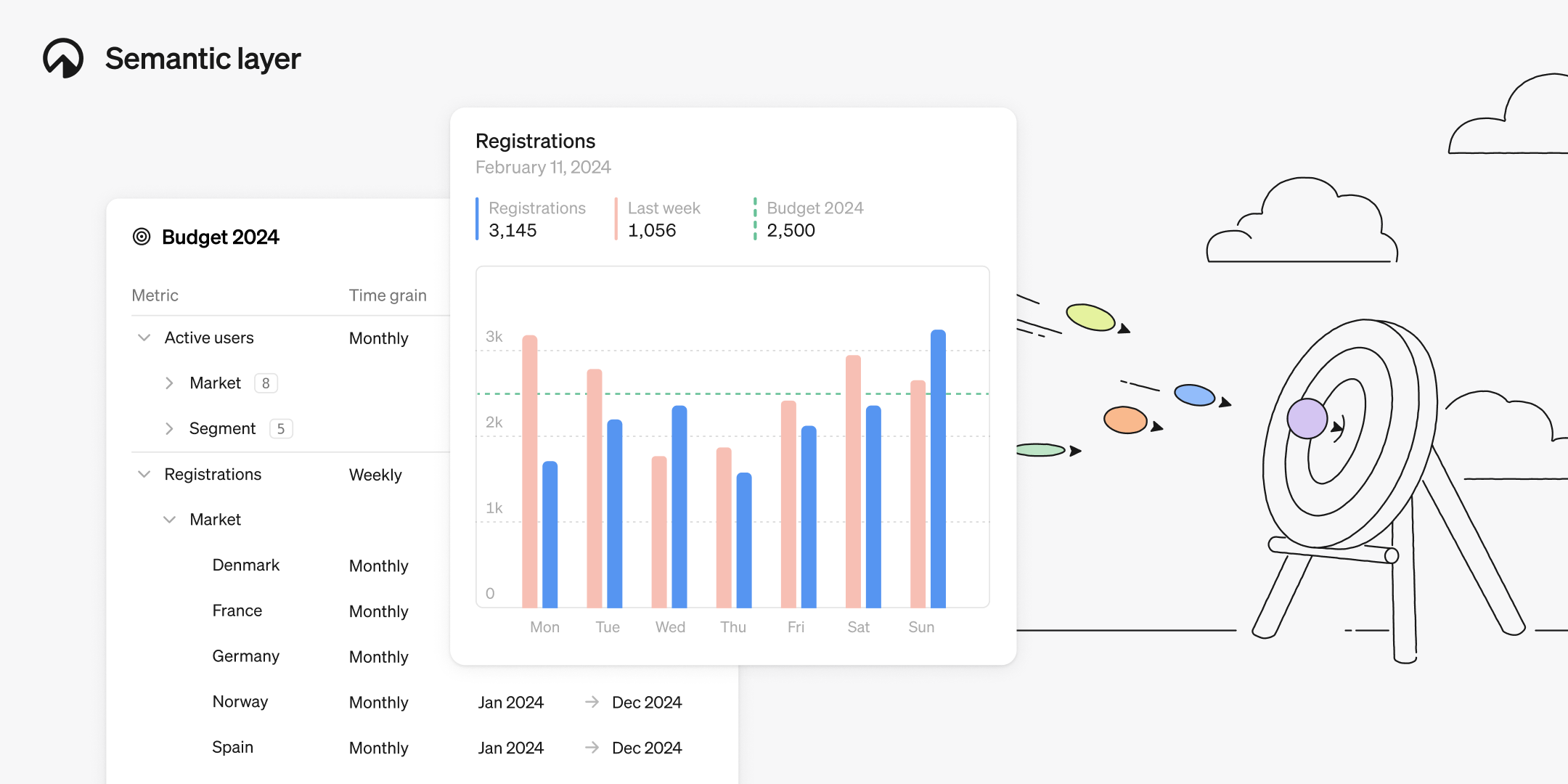
TL;DR: Adding targets to your BI visualizations remains unreasonably hard. It frustrates your business controller peers while draining your team's time. Current approaches are essentially hacks and the time has come for a proper solution.

How hard can it be?
How can a task that looks so easy from the outside cause so much headache?
- In traditional BI tools, we're adding targets using local logic, so they need to be added manually by analysts in multiple places.
- Targets typically change multiple times throughout the year with short deadlines. Business controllers are dependent on analysts' limited time to make updates without versioning or central control.
- Managers need to use targets in a number of different places in order to do reporting and communication. It's really hard for analysts to give them flexible support on this kind of very specific work.
This combination predictably makes for frustrated stakeholders and unhappy analysts.
Targets and the semantic layer
Using a Semantic Layer and metrics-based BI opens up a new potential solution - centralized targets data connected to specific metrics and dimensions. In this paradigm, metrics have an identity, and with the centralized control you get from a semantic layer, you can now connect target data to your metrics, essentially like foreign keys in a database.
Combine that with composable analysis, where end users can freely combine metrics and targets from the semantic layer, and it opens up a whole new way of working.
The dream is close
We love this new way of working with targets. In Steep, you can load target data next to your semantic layer and make the relevant targets available when exploring and analyzing all your metrics.
This means that all managers can now overlay the right targets on top of their metrics without having to go through an analyst. And business controllers can even add multiple versions of targets (Budget, Budget v2, etc) and compare them to each other (they love this stuff).
Google Sheets integration is coming - by supporting loading targets data straight from Google Sheets we can finally achieve target nirvana, letting business controllers and managers control the whole process end-to-end with no support needed
Book a demo
Get help with exploring the platform and discussing use cases for your team.
Get started
Explore for free. Get your own workspace or try the demo setup.
More posts

What is a semantic layer?
By Natasha Ellis-Knight·Data culture

Intro to Steep
By Janna Pollari·Events
Webinar with Daana
By Janna Pollari·Events

Meet us at Snowflake Summit 2026
By Deanne Anderson·Events
Introducing Steep AI
By Nino Höglund·Product

A builder's guide to the Steep API
By Hanna Kjellén·Inside Steep